
 Bengali foods
 Best Mughlai
 Biryani
 Carrot Juice
 Chaat
Chaat Cheese Burger
 Chinese
 Cold Coffee
 Continental
 Cupcake
 Dessert
 Dinner
 Doughnut
 Drum Stick
 Fast Food
 Fresh Juice
 Gujarati Foods
 Homemade Meals
 Homemade Sweets
 Hot Dogs
 Ice Cream
 Indian Foods
 Italian
 Kebabs
 Lunch
Lunch Magi
Magi Noodles
 North Indian
 Pastry
 Pizza
Pizza Potato Fries
 Prawns
 Punjabi
 Salad
Salad Sham pane
 Shawarma
 South Indian
 Stakes
 Tandoor
 Tea
Tea Thai
Thai
Posted by Reviewtale
- Oct 27, 2025
- 765
- 1
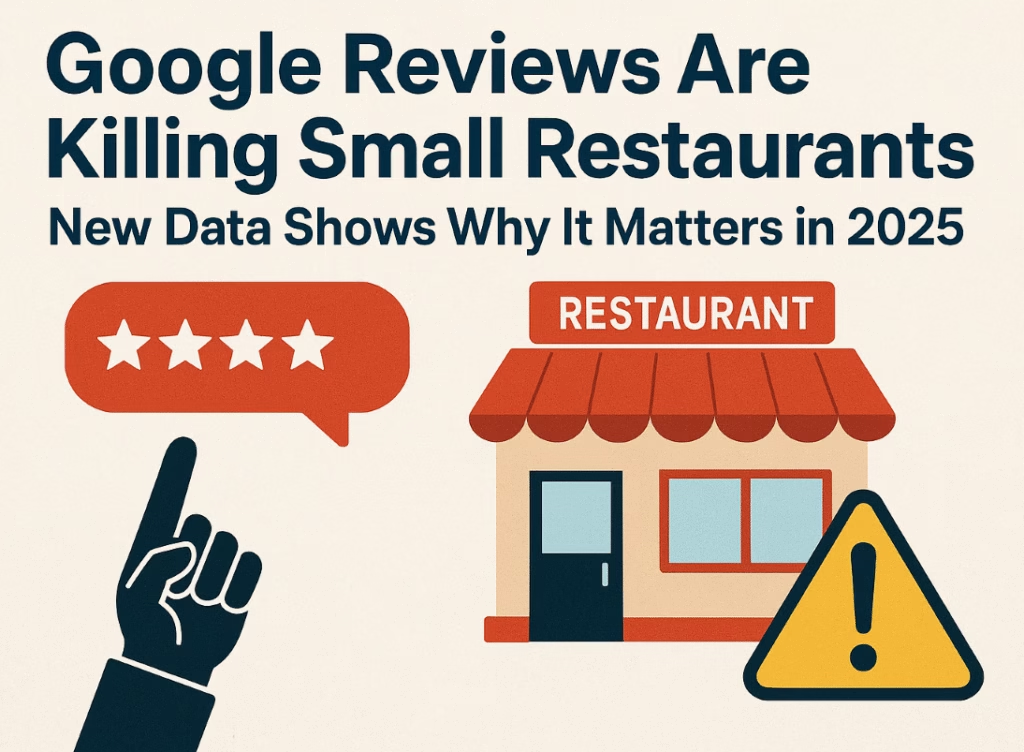
Google Reviews Are Killing Small Restaurants: New Data Shows Why It Matters in 2025

Do Google reviews really influence where people choose to eat? When it comes to restaurants, the impact is stronger than most owners realise. Recent studies show that Google reviews play a major role in online decision making across nearly every industry. In the restaurant space, the effect is even more dramatic. About 94 percent of diners decide where to eat based entirely on online reviews, and Google remains the platform they trust the most. For small, independent restaurants, even a 0.3-star drop on Google can lead to a 13 percent decline in peak-hour bookings. Meanwhile, large chains continue to pull ahead, thanks to higher review volume and better resources to manage their online reputation.
According to recent data, restaurants with ratings below 4.0 stars experience a 72% drop in search visibility compared to those above 4.3. This digital divide has created an increasingly challenging landscape for small restaurateurs who lack dedicated reputation management teams. Furthermore, small restaurants experience significantly higher revenue volatility from negative reviews, with a 0.5-star drop potentially decreasing annual revenue by up to 9%. This article examines why Google reviews disproportionately impact small restaurants in 2025, the financial consequences they face, and practical strategies to effectively manage online reputation without substantial marketing budgets.
How Google Reviews Influence Restaurant Discovery in 2025
The restaurant discovery journey almost always begins with a digital search, not word-of-mouth recommendations. Research indicates that a striking 90% of potential diners research restaurants online before making a decision. Among these digital explorers, 46% check Google Reviews first, making it the primary platform for restaurant discovery.
Google Map Pack Ranking and Review Volume Correlation
The coveted Google Map Pack—those three business listings displayed prominently at the top of search results with a map—appears in over 30% of searches and receives approximately 70% of organic search traffic. For restaurants seeking visibility, understanding what drives Map Pack placement has become essential.
Review volume shows a direct correlation with Map Pack positioning. Businesses appearing in the top position typically have more positive reviews than those in positions 2 and 3. In fact, reviews account for 17% of ranking factors in the Map Pack, while only contributing 5% to general organic search rankings.
Several key factors determine a restaurant’s position in the Map Pack:
- Review keyword relevance (20.2%) – mentions of menu items or cuisine type
- Google Business Profile relevance (19.6%) – complete and updated information
- Review count (13.7%) – total volume of customer feedback
- Rating (6.5%) – overall star rating
Notably, while proximity to the searcher remains important, restaurants benefit from customers’ willingness to travel slightly farther for well-reviewed options.
Impact of Star Ratings on Click-Through Rates
Star ratings dramatically influence whether potential diners click on a restaurant listing. Research shows that 56% of consumers select businesses based primarily on positive reviews and good star ratings, rather than their position in search results.
The difference between a 4.0 and 4.5-star rating might seem minor but can result in substantial differences in customer engagement and foot traffic. In the hospitality world, each additional star on review platforms can increase revenue by 5-9%.
What’s particularly surprising is that studies suggest having no star rating at all is preferable to displaying a low 1-2 star rating. Moreover, customers demonstrably spend 31% more at businesses with excellent Google reviews.
Search Visibility Drop for Restaurants Below 4.0 Stars
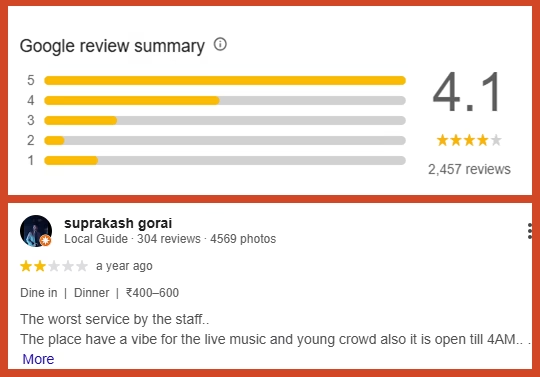
The threshold for acceptability has risen steadily, with the average star rating in Google’s Map Pack now sitting at 4.1. Consequently, restaurants falling below this benchmark face severe visibility challenges.
A decisive 33% of diners flat-out refuse to eat at restaurants with less than a 4-star rating. Additionally, 84% of consumers are more likely to trust a restaurant with a high volume of recent Google reviews.
The system creates a self-reinforcing cycle—higher-rated restaurants gain more visibility, which leads to more clicks and visits. As a result, restaurants with ratings below the 4.0 threshold experience declining search visibility, making it progressively harder to attract new customers.
This digital filtering process happens before potential customers ever taste a restaurant’s food. Once a restaurant falls below the crucial 4-star threshold, diners often filter them out entirely when searching for places to eat. One negative online review can cause a restaurant to lose up to 22% of potential customers, creating a substantial barrier for small establishments trying to build their digital presence.
The Financial Toll of Negative Reviews on Small Restaurants
The concrete financial impact of negative reviews extends beyond mere visibility issues for small eateries. Numbers tell a sobering story about how digital opinions directly affect restaurant bottom lines across America. For more detailed information about how to handle negative reviews, you can read our article on ‘5 Best Ways to Handle Negative Reviews: A Complete Guide for Restaurants.’
Revenue Loss from 0.5 Star Rating Drop
The relationship between star ratings and revenue is remarkably precise. Research demonstrates that a one-star increase in Yelp rating leads to 5-9% growth in revenue for independent restaurants. This relationship works equally in reverse—even a modest half-star rating drop can slash a restaurant’s revenue by a similar percentage. For a typical mid-to-high-end restaurant, this translates to approximately $816 in weekly pre-tax profit loss.
Small restaurants operate on notoriously thin margins, typically between 3-5%. Hence, any rating-related revenue decline quickly becomes existential. Studies reveal that consumers overwhelmingly select restaurants based primarily on star ratings. Even more concerning, crossing certain rating thresholds creates disproportionate effects—dropping below 4.0 stars can trigger a dramatic 20% decline in sales.
Financially, this creates a downward spiral. As one negative review drives away approximately 30 potential customers, the compounding effect stretches beyond immediate lost sales into long-term profitability concerns. For a local restaurant where average sales might be $500 per customer, a single negative review viewed by 200 potential diners could cost up to $80,000 annually.
Booking Decline During Peak Hours
Negative reviews hit hardest during precisely the hours restaurants need most—peak dining times. Higher-rated establishments consistently sell tables 19% more frequently during these crucial periods. Conversely, after receiving poor reviews, restaurants experience between 1.8-3.2% reduction in sold-out probability during prime hours.
The effect intensifies for establishments without established reputations. Independent restaurants without expert accreditation sell out 27% more often if they earn just one extra star. A 3.5-star rating bumped to 4.0 stars can increase peak-hour bookings by 19%—representing thousands in monthly revenue during times when tables should be consistently filled.
This dynamic creates a particularly troubling scenario for newer or struggling restaurants. Without consistently filled tables during high-demand periods, covering fixed costs becomes increasingly challenging, further limiting resources available for quality improvements that might help raise ratings.
Case Study: 2024 Yelp Data on Independent Restaurants
Recent Yelp data from 2024 illuminates how these challenges are intensifying. New restaurant openings continue growing, yet at a decelerated rate—dropping from 6% to 4% year-over-year. Simultaneously, high-end independent establishments face particularly strong headwinds, with categories including New American (down 46%), Teppanyaki (down 40%), and Modern European (down 36%) experiencing significant declines.
The data reveals a troubling adaptation pattern: independent restaurants increasingly implement cost-cutting measures replacing traditional table service. Mentions of “counter service” rose by 203% as establishments struggle to maintain profitability while facing rating challenges.
Financial analysis from 2024 demonstrates that higher average star ratings (ASR) remain strongly associated with increased weekly sales across both quick service and full-service segments. For perspective, a 3.1% increase in annual sales represents an additional $39,000 for a quick-service restaurant and $125,000 for a casual dining establishment.
Yet throughout these financial challenges, chain restaurants remain largely insulated from these effects. Multiple studies confirm the impact of online reviews on revenue is “close to zero for chains”, creating an increasingly uneven competitive landscape where independent restaurants bear disproportionate financial risk from their digital reputation.
Why Small Restaurants Are More Vulnerable Than Chains
Independent eateries face unique challenges in the digital reputation landscape that their chain counterparts simply do not encounter. Research reveals a striking disparity: a one-star improvement in Yelp ratings translates to a 5-9% revenue increase for independent restaurants, yet the impact is “statistically insignificant and close to zero for chains”. This fundamental difference creates an uneven playing field where small restaurants must navigate review platforms with extreme caution.
Lower Review Volume and Higher Volatility
Small restaurants inherently generate fewer reviews than established chains, creating a mathematical disadvantage that amplifies each negative comment. With fewer total ratings, each one-star review dramatically impacts the overall average. This volatility means that while chain restaurants maintain stable ratings across hundreds or thousands of reviews, independent establishments can see their star rating plummet overnight from just a handful of negative experiences.
The imbalance extends beyond mere numbers. At chains, nearly half of all reviews were one-star—showing an overwhelming negative bias. Yet despite this negativity, chains remain protected by brand recognition and established customer bases. Independent restaurants, however, depend much more heavily on positive Google reviews, which they fortunately receive about 41% of the time. Nonetheless, the mathematical reality remains: being an independent restaurant results in approximately a 1-star reduction in rating relative to a comparable chain restaurant.
Lack of Dedicated Reputation Management Teams
Chain restaurants typically employ specialized teams dedicated to online reputation management, whereas independent owners must juggle this responsibility alongside daily operations. The director of Technology and Innovation Policy at the Restaurant Association notes, “In today’s digital economy, a restaurant’s online presence and reputation is just as important as the physical location of its storefront”.
Unfortunately, many small restaurants “either do not understand the impact to business or do not know exactly how to deal with negative online reviews”. Without dedicated resources for monitoring Google reviews daily, they often miss opportunities to respond quickly and mitigate damage—a critical factor since swift responses significantly reduce negative impacts.
Disproportionate Impact of One-Star Reviews
Above all, small restaurants face existential threats from negative reviews that chains simply do not. A single negative review can drive away 22% of potential customers, while three negative reviews can push that number to 59%. For independent restaurants operating on razor-thin margins, such customer loss often proves catastrophic.
The vulnerability has intensified so much that review extortion schemes now specifically target small restaurants. Scammers leave one-star ratings then demand payment to stop the attacks. These “reputation attacks can be damaging to restaurants, many of whom are operating on razor-thin margins as they deal with supply-chain strain and labour challenges”.
This imbalanced system creates a gradual shift in market share. Indeed, as review platforms gain popularity, evidence suggests they actually contribute to independent restaurants losing market share to chains—precisely the opposite of what many consumers might expect from increased transparency.
Responding to Negative Reviews: What Works and What Backfires
Responding effectively to online criticism often becomes the difference between recovering from a negative review or allowing it to permanently damage a restaurant’s reputation. The approach taken can either rebuild customer trust or further alienate diners. For more insights, click here.
Empathetic vs Defensive Response Tone Analysis
Research demonstrates that an empathetic response significantly outperforms defensive reactions. Starting with an apology and acknowledgment, regardless of whether you agree with the complaint, establishes goodwill. In contrast, defensive replies that justify mistakes or blame circumstances typically backfire, appearing unprofessional to prospective customers. A study shows 83% of individuals prioritize businesses that respond to and resolve their complaints. Successful responses focus primarily on commitment to service (not excessive apologies, which comprise only 13% of effective responses).
Public vs Private Response Outcomes
The initial response should always be public, yet brief and professional. This functions as both customer service and marketing—showing prospective diners how you handle problems. Afterward, shifting the conversation offline proves most effective. Providing direct contact information signals genuine concern while preventing potentially damaging public exchanges. For serious complaints, offering ownership/corporate contact information demonstrates accountability. This dual approach maximizes recovery potential: the public sees your responsiveness while allowing for personalized resolution away from scrutiny.
Timing of Response and Customer Re-engagement Rates
Response speed directly correlates with customer retention rates. Data reveals 53.3% of customers who write reviews expect responses within 7 days, though ideally, restaurants should respond within 48-72 hours. The re-engagement opportunity is substantial—66% of customers indicate willingness to return if management responds to their feedback. Likewise, 44.6% of consumers report being more likely to visit establishments where owners address negative reviews.
Notably, the necessity for prompt response increases with review severity—one-star and two-star reviews demand faster attention than neutral or positive ones. Throughout the process, maintaining a consistent tone of hospitality remains essential, as 75% of consumers will forgive a mistake following excellent service recovery.
Strategies to Encourage More Positive Reviews in 2025
Generating positive Google reviews requires strategic action rather than passive hope. Restaurants that implement systematic approaches see significantly higher review volumes and ratings.
Post-Meal Review Prompts via QR Code Payments
QR code payments create natural opportunities for review collection. Modern payment solutions allow customers to rate their experience immediately after settling the bill, when impressions remain fresh. These systems streamline the process by connecting payment and feedback in one interaction. Customers scanning QR codes for payment can be prompted with a star rating request and directed to Google Reviews with a single tap. This approach is particularly effective as it removes barriers between satisfaction and feedback. Studies show QR codes on receipts linking directly to review platforms substantially increase review completion rates.
Staff Training to Ask for Reviews Naturally
Proper staff training transforms employees into review advocates without appearing pushy. First, normalize review requests as standard practice, creating scripts that feel comfortable and authentic. Effective scripts acknowledge satisfaction first: “Was everything okay with the service? Great! As a local business, we rely on reviews—would you mind sharing your experience?” Timing proves crucial—ask several minutes before customers leave while they’re still enjoying the experience. Training should emphasize asking during natural service interactions when positive feedback is received verbally.
Follow-Up Emails and SMS with Review Links
Post-visit communications generate substantial review volume when properly executed. Messages should arrive within 24-48 hours while experiences remain top-of-mind. Effective SMS templates keep requests under 160 characters, mentioning specific details about their visit. For example: “Hi [Name], thanks for dining at [Restaurant Name] last night. We’d love to hear about your experience. Would you mind taking a moment to share a quick review with us? [Review Link]”. For email, personalized references to specific dishes or servers increase response rates.
Incentivizing Feedback Without Violating Platform Policies
Incentives must avoid violating platform terms. Instead of direct rewards for positive reviews, offer incentives for all honest feedback regardless of rating. Consider alternatives like charity donations—“We’re donating $1 to charity for every review we receive this month”. Alternatively, implement loyalty programs offering points for feedback without requiring positive sentiment. Small future rewards work better than immediate discounts; offering free appetizers on return visits encourages both feedback and repeat business.
Conclusion
The digital review landscape clearly creates an uneven playing field for small restaurants compared to their chain counterparts. Small establishments face a harsh reality where a minor rating drop translates to substantial financial consequences. Additionally, the mathematical disadvantage of lower review volume makes independent restaurants exceptionally vulnerable to reputation volatility.
Therefore, small restaurant owners must recognize online reputation management as essential rather than optional. Responding promptly and empathetically to negative feedback, training staff to naturally request Google reviews, implementing QR code payment systems, and sending timely follow-up messages all serve as practical tactics within reach of even modest marketing budgets.
The stakes remain remarkably high. Though chains enjoy relative immunity from review impacts, small restaurants stand to gain or lose thousands in revenue based solely on digital opinions. Undoubtedly, this disparity continues widening as consumers increasingly rely on Google reviews as their primary discovery method.
What matters most for small restaurants is adopting a proactive rather than reactive approach to reputation management. Those who systematically implement review-generation strategies while maintaining quality service standards will likely thrive despite these challenges. The others risk becoming casualties of an increasingly review-driven restaurant economy where visibility, bookings, and revenue all hinge on maintaining that critical 4-star threshold.
Small restaurant owners who adapt accordingly can transform this challenge into an advantage, using authentic customer feedback to refine operations while steadily building a positive digital reputation. After all, each positive review not only improves ratings but serves as powerful word-of-mouth marketing that chains simply cannot replicate.
Recommended Posts

- Feb 1, 2025
- 674 read
How Behind-the-Scenes Food Content Boosts Visibility & Engagement Table of ContentsIntroductionThe Power...
Read Article
- Jan 29, 2025
- 653 read
7 Effective Ways to Use Customer Reviews to Build Trust Table of...
Read Article
- Jan 19, 2025
- 1116 read
The Story Behind Your Business: How Sharing It Attracts Customers & Builds...
Read Article
- Jan 18, 2025
- 1266 read
Unforgettable Dining Experiences: How a Unique Selling Proposition Can Elevate Your Restaurant...
Read Article
- Jan 16, 2025
- 2005 read
What Unique Aspects of Your Restaurant, Cloud Kitchen, or Café Set You...
Read Article
- Jan 12, 2025
- 978 read
How to Remove Negative Reviews From Google? Negative reviews on Google can...
Read Article
- Dec 25, 2024
- 711 read
6 Essential Steps for Restaurants: Masterfully Choose the Right Target Customers Choosing...
Read Article
- Dec 5, 2024
- 1190 read
10 Powerful Tips for Innovative Menu Design: Trends You Need to Know...
Read Article
- Nov 16, 2024
- 617 read
Tips and Tricks to Optimize Your Restaurant Profile: Improve Your Online Visibility...
Read Article